Showing posts with label Henry Miller. Show all posts

Wednesday, October 19, 2011

Dr. Henry D. Miller speaks at Bunche Center Authors' Series Friday, October 14th (UCLA)

Presents

DR. HENRY D. MILLER

Director / Playwright

FRIDAY, OCTOBER 14, 2011

Library and Media Center – Haines Hall

12 Noon – 1:00 PM

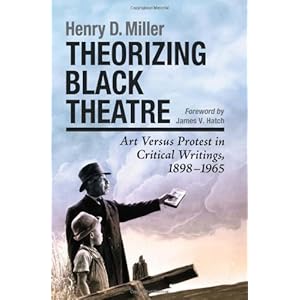
Dr. Henry D. Miller’s book, Theorizing Black Theatre: Art Versus Protest in Critical Writings, 1898-1965, is his latest literary work. His collection of one-act plays, Songs of the One-Act Muse, and his full-length play, My Brother’s Keeper have been published by the Alexander Street Press and made available on CD Rom as part of the Black Drama Anthology. Miller is a veteran of the 1960s and 1970s black theatre movement. A director and playwright, he has written broadly about American theatre. The rich history of African-American theatre has often been overlooked, both in theoretical discourse and in practice. This volume seeks a critical engagement with black theatre artists and theorists of the twentieth century. It reveals a comprehensive view of the Art or Propaganda debate that dominated twentieth century African-American dramatic theory. Among others, this text addresses the writings of Langston Hughes, W.E.B. DuBois, Lorraine Hansberry, Amiri Baraka, Sidney Poitier, and August Wilson. Of particular note is the manner in which black theory collides or intersects with canonical theorists, including Aristotle, Keats, Ibsen, Nietzsche, Shaw, and O'Neill. All-day parking ($11) and short-term parking (payable at pay stations) are available in Lots 2, 3 and 4 (enter the campus at Hilgard and Westholme avenues). For more information, call 310-206-8267 or click the post's title for more information.


Wednesday, September 21, 2011

Ebony Repertory Theatre presents “Back to The Future: In Search of a New Black Theatre Aesthetic” 10/14-16 (LA)

Ebony Repertory Theatre
presents
“Back to The Future: In Search of a New Black Theatre Aesthetic”
A 3-day theatre symposium
October 14-16, 2011
Featuring the Writings of
Henry Miller, Ph.D.

Ebony Repertory Theatre (“ERT”) invites the public to join them for an in-depth 3-day Theatre Symposium of play readings and panel discussions from October 14 to 16, 2011, featuring actors, directors, producers, union representatives, casting directors, designers, and scholars, as they examine the historical and contemporary theatre landscape. The work of Dr. Henry Miller, author of the new “milestone” book, Theorizing Black Theatre: Art vs. Protest in Critical Writings, 1898-1965, will be the focus of our symposium, with the goal of determining “Where do we go from here?” Throughout the weekend, all of the events presented are designed to include discussion with the panelists and the symposium attendees. Additionally, panels one through three will also include the reading of scenes from some of Dr. Miller’s plays: That Word, 3 Scenes Before A Door, Perfectly Black: Seductions In An Alternate Cosmos Of Negritude, Grandma’s Hands, and Eulalie Spence’s Harlem Renaissance play, Undertow (1929).

Although the tickets are free, reservations are required. To learn more and to make reservations, please click the post's title.

Monday, September 5, 2011

Call for Actors Friday, Sept 9th (Harlem)


Please click images to enlarge.

Monday, June 27, 2011

AAPEX Book Review: Dr. Henry Miller's THEORIZING BLACK THEATRE


Subway Reading: THEORIZING BLACK THEATRE

I thought that I would read Dr. Henry Miller's new book from cover to cover before writing a review, but I quickly discovered that THEORIZING BLACK THEATRE is not that kind of book.


THEORIZING BLACK THEATRE is the kind of book that you KEEP in your backpack and take out on the subway with pen in hand so you can take notes. Every couple of pages you will go over enough material to constitute an undergrad course in African American theatre and dramaturgy.

For instance, I have had the book for several months and have made it to Chapter 2, page 77. For every hour I have spent reading, I have spent 5 at the computer googling a whole new world of American theatre artists whose contributions have not been recognized in any theatre history book I have ever read. At this point, I am fixated on a playwright named Angelina Grimke (1805 - 1879) and her circle and the movement of African American dramaturgy from musicals to drama, as it is recognized in Grimke's anti-lynching drama RACHEL.

Theoretically, THEORIZING BLACK THEATRE is about the dialectic between Art & Propaganda in African American drama, but in pursuing this line of discourse, Dr. Miller gives us a whole new look at out country and begins to undo the damage that segregation has done to our historical perspective, especially as it is taught to us as students of American history and culture. Anyone who is fascinated with who we are needs to grab a copy of Dr. Miller's book & a pen and just get on the A train and read.

Jaz Dorsey
Dramaturg
The African American Playwrights Exchange
Nashville, Tennessee


Please click the post's title to buy the book on Amazon.com.

Sunday, June 19, 2011

Book Review: Henry Miller's Theorizing Black Theatre

Please click to enlarge.

From the Spring 2011 edition of Broadside, the journal of the Theatre Library Association. To learn more about the TLA, please click the post's title.

Monday, January 17, 2011

Theorizing Black Theatre: Meet the Author Jan 30th

Please click image to enlarge.

Tuesday, February 12, 2008

Friday, February 8, 2008

Sparkplug and Miss Jonnie Mae at La Mama 2/18 (NYC)

Sparkplug and Miss Jonnie Mae

Written By
Owa
Directed By
Henry Miller

A larger-than-life work in a short two character play.
Sparkplug and Mis Jonnie Mae--- an amusing, gender bending absurdist romp in the fairyland of the mind. Seduction influenced by the effects of love on two lonely persons, creates a storm of events where the intervention of nature and conventions of conduct in 1930's Southern American Society exposes a heart wrenching dramatic impasse.

With

Scott Williams and Kyle Minshew


Black history month: electric Poetry
Hosted by William Electric Black at

La Mama Etc
74A East 4th St. NY, NY 10003
8 p.m. Monday February 18th 2008
Tickets $7.00

With special thanks to Kim Weson-Moran/Rhymcolors associate

Saturday, September 22, 2007

Absurdism: African-American Style

Absurdism: African-American Style
It is always difficult, perhaps even culturally imperialist, to define black or African-American art, including theatre and drama, in essentially European terms. And the absurdist movement in the theatre, as the famed theatre critic Martin Esslin identified it almost a half century ago is, on the surface at least, European. In many historical ways this 1950s movement can be understood as a natural reaction to the centuries-old rigid and rule-ridden domination of European thinking by the Catholic Church since the middle-ages and by neoclassicism in the arts since the 16th century. After all, as we are nowadays pleased to forget, this age-old system of European hide-bound rules and regulations down to World Wars One and Two had, in fact, presided over almost a millennia of religious and political wars that make Osama Bin Laden and his so-called Islamic terroists look like school yard neophytes in the business of killing innocent people in absurdly large numbers. Given this history, it is quite natural then that a group of sensitive, mid 20th century European artists would feel it necessary to finally engage the fundamental aburdity of life as they and their ancestors had experienced it for centuries--a life that had long been hidden behind the pomp, ceremony, and the much-praised continued progress of European society.

However, African American absurdism--again, if such a term can be used and if it is not merely mimicking someone else's history and culture--comes from its own much older existential source of a cosmic duality, experienced in its most contemporary and concrete form as American racism. That the cosmos is a precarious place, apparently composed of inexplicably bound opposites or contradictions, life and death, good and evil, etc., appears to our merely mortal minds as the height of absurdity. Yet, this notion of duality is taken up in the world's oldest extant drama, ancient Egypt's Abydos Passion Play (1868BC), performed, or more accurately celebrated, at least 1300 years before the rise of classical Greek drama, and also taken up in Nigerian performances depicting the Orisha god Eshu whose face is half a frown and half a smile, an emblem of the seemingly absurd duality of human existence. The African American music forms, the Blues, Spirituals, and Jazz are also all emblematic of the kind of duality that has opposites so closely related that they lead us to the almost liminal space of the absurd. The Blues, performed properly, is both funny and sad, and a traditional New Orleans, black American funeral uses music to rejoice at death just as the ancient Egyptians rejoiced annually at the descent of the god Osiris down into the world of the dead.

Accepting, laughing at, and even celebrating the seemingly absurd contradictions of human existence is a staple of traditional African and African American culture and it is, at least up until now, one way, consciously or unconsciously, that black Americans have, for the most part, maintained their humanity and survived all the absurdities that arise from being both a descendant of Africa and an American at the same time, of being a human being and a piece of property at the same time, of living in a police state and a democracy at the same time, of fighting for your country in every war from the American Revolutionary war down to the Iraq war and still not quite becoming a full American cititzen at the same time.

In THAT WORD, as in the Blues, I encourage laughter at the absurd and sad truth that the black American theatre has always needed people outside of black culture to validate its value. It's sort of like the absurdity of a group of Japanese theatre-goers waiting patiently for me to arrive in Tokyo to give them the last word on Kabuki theatre. And, more importantly, I am encouraging the audience to laugh at what is the ultimate sad absurdity in this short play, which is that so many black Americans seem to accept only their historical oppressors' pejorative meaning for the word "nigger." The historically non-pejorative usages of the word within the framework of their own traditional cultural history has no import for them. "That's cool," "It's the death," "That's really bad, my man," "You, my nigga," "It's the bomb" are all emblematic of that traditional ancient African and Asian cosmos in which good and bad as we percieve them are inextricably bound and therefore sometimes interchangeable. An ancient Japanese proverb wisely reminds us of this relationship and its interchangeable nature: "For surely good must come from evil. For even the lily springs from the slime of the pond."

But the ancient origins and philosophical sublties of what is commonly (and often pejoratively) called "Black English" are apparently unknown to these contemporary black folks. All they know is that Massa Jeff said it was a bad word, used it as a bad word, so it must be a bad word, and this, of course, empowers not them but their oppressors yet again, and this time in the 21st century! This situation is so sad and fraught with so much politically correct ideology and with so little attention to human behavior and psychology that I think it is at present beyond rational argument. Only laughter has a chance of having us take a fresh look at this issue.

Henry Miller,
THAT WORD
playwright

Friday, September 7, 2007

"That Word: An Evening for Reflection" at Cafe Coco 9/11 (Nashville)

The African American Playwrights Exchange invites you to join us on Tuesday, September 11 for "THAT WORD: An Evening for Reflection" at Cafe Coco, 210 Louise Avenue in Nashville, Tennessee.

On a day when Americans now stop to remember and confront the nightmare of terrorism, this cabaret evening is a reminder that terrorism does not necessarily come from beyond and that bombs are not terrorists' only tools. In two short pieces, AAPEX writers Henry Miller and Elizabeth Davidson confront the "n" word. In her one woman show on Harriet Beecher Stowe, Davidson puts the word in it's historical context while Dr. Miller defuses THAT WORD in his highly acclaimed short comedy about two black performers and the steps they take to avoid using "that word." The two pieces will be bridged by the classic Billie Holiday song "Strange Fruit"

Robert Kiefer directs Davidson in HARRIET BEECHER STOWE: A LITERARY SOLDIER
Helen Shute Pettaway directs Nubian and marc anthony peek in THAT WORD

The event will run from 6:30 until 8 PM and is free to the public.

Thursday, May 10, 2007

Two AAPEX Writers Have NYC Readings This Weekend

Two writers from The African American Playwrights Exchange will enjoy readings of their work this weekend in New York City.

  • Henry Meyerson
    JUMP JIM CROW
    Saturday, May 12, 12 Noon
    Booker T. Washington Heights JHS
    103 W. 108th St.
    Between Amsterdam and Columbus
    Strollers Players Readers Theater Workshop
  • Dr. Henry Miller
    MY BROTHER'S KEEPER
    Marjorie Eliot's Parlor Entertainment
    555 Edgecombe Ave @ 160th Street
    Sunday May 13th at & pm
    Jazz from 4 pm
    212-781-6595

Friday, May 4, 2007

Free "My Brother's Keeper" Reading (NYC)

Marjorie Eliot's Parlor Entertainment
Presents a Reading
of the Two-act Play
MY BROTHER'S KEEPER
By
Henry Miller
(Member: African American Playwrights Exchange & Dramatist Guild of America)


Location:
555 Edgecombe Avenue @ 160th Street, NYC, Apt #3F - 212-781-6595 (1 Block East of St Nicholas Avenue) . The nearest train station is the IND line @ 163rd St. CC local.

Date & Time:
Sun. May 13, 2007 @ 7pm

Readers:
ARTHUR FRENCH (Obie Award-winner, founding member: NEC) reading Mr. Newborne

LAWRENCE WINSLOW reading Lucas Newborne

CANDICE MYERS reading Dana Askew

BRIGITTE BARNET reading Margaret "Zulima" Newborne

ED SHELDON reading Mayor Jacob A. Lyman

&

ERIC COLEMAN reading Marcus Newborne


This reading will be hosted by Marjorie Eliot who starred in Charles Gordone' seminal, Pulitzer Prize-winning African American drama, No Place to be Somebody. Also a jazz pianist, Ms. Eliot is the founder of Parlor Entertainment, Harlem's internationally recognized "Straight-Ahead" Sunday Afternoon contemporary Jazz venue.

ADMISSION IS FREE!
So eat a big late lunch and come early at 4pm and make it an afternoon of Jazz and an evening (7pm) of African-American Drama.